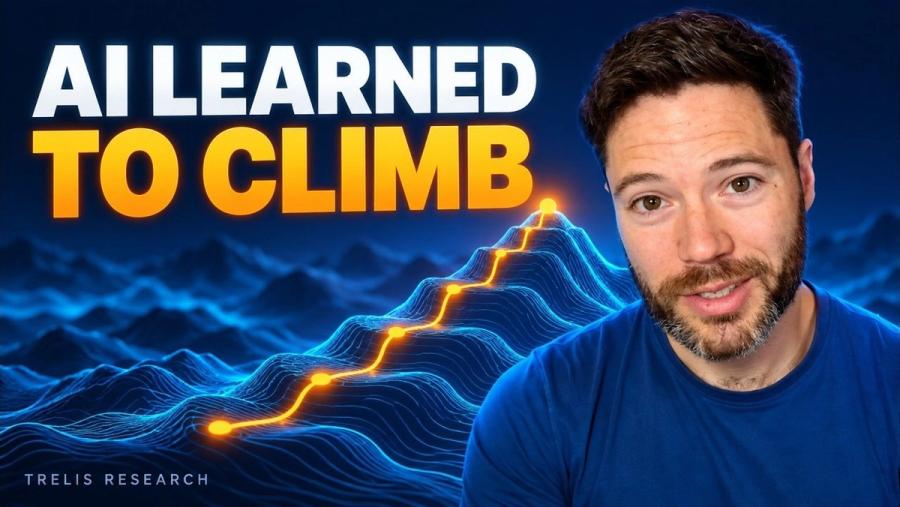
AI Trial and Error Replaces Human Teachers in Weaker Models
AI learning is shifting from rigid, teacher-driven methods to flexible, student-driven approaches. Techniques like GRPO are now effectively training weaker AI models that struggled with traditional supervised fine-tuning.
The landscape of artificial intelligence training is undergoing a significant paradigm shift, moving away from traditional, teacher-guided instruction toward more adaptive, student-driven learning methodologies. For a period, weaker AI models often faltered when subjected to conventional supervised fine-tuning, struggling to assimilate complex tasks accurately. This reliance on predefined, rigid instruction proved a bottleneck for scaling up less robust models across various applications.
Recent advancements have demonstrated the efficacy of techniques such as Guided Reinforcement Policy Optimization, or GRPO, in overcoming these limitations. Instead of requiring extensive, meticulously labeled datasets provided by human experts, these newer methods allow the AI model to learn through iterative interaction and self-correction, mimicking a more organic, trial-and-error educational process.
This transition is not merely a technical refinement; it carries substantial implications for the accessibility and deployment of AI. By reducing the dependency on vast, expensive, and time-consuming human annotation efforts, organizations can now effectively train and deploy more capable, albeit initially weaker, AI models across sectors like healthcare, finance, and localized service industries.
The impact suggests a future where AI development is less about perfecting the initial instruction set and more about optimizing the learning environment itself. This shift democratizes AI development, allowing smaller teams and resource-constrained environments to build sophisticated models without the prohibitive overhead historically associated with high-quality human-in-the-loop training.
Also Read

मनीषा भानवाला बनीं भारत की पहली विश्व चैंपियन महिला पहलवान
मनीषा भानवाला ने वर्ल्ड रेसलिंग चैम्पियनशिप में गोल्ड जीतकर इतिहास रचा है। उन्होंने आखिरी तीन मिनट में मुकाबला पलटकर भारत को यह प्रतिष्ठित खिताब दिलाया।
The shift towards trial and error methodologies, exemplified by the successful application of GRPO, signals a significant evolution in how artificial intelligence models, particularly those with limited initial capacity, are developed. This move away from strictly supervised fine-tuning addresses a critical bottleneck where weaker models often failed to absorb complex patterns through conventional, pre-labeled data instruction. The significance lies not just in the technical success of GRPO, but in democratizing advanced AI training, making robust model development accessible even for less powerful computational architectures.
The potential impact extends across various sectors reliant on AI, including specialized industrial automation, localized healthcare diagnostics, and resource-constrained educational technology. Previously, achieving functional performance in smaller or less data-rich environments required substantial human curation and high-quality, expensive labeled datasets. Trial-and-error learning reduces this dependency, potentially lowering the barrier to entry for deploying practical AI solutions in regions or industries lacking extensive data infrastructure.
What to watch next is the scalability and robustness of these self-correcting learning loops. Researchers must now focus on mitigating the inherent inefficiencies and risks associated with purely exploratory learning, such as excessive computational expenditure or the generation of unpredictable, non-aligned outputs. Further investigation into how these weaker models generalize beyond the specific training environment, and whether GRPO can maintain safety guardrails while exploring, will be crucial for real-world adoption. The transition suggests a future where AI learning is less about perfect instruction and more about intelligent, iterative discovery.