NVIDIA Vera Rubin: The AI Supercomputer Platform Reshaping the Future of Computing
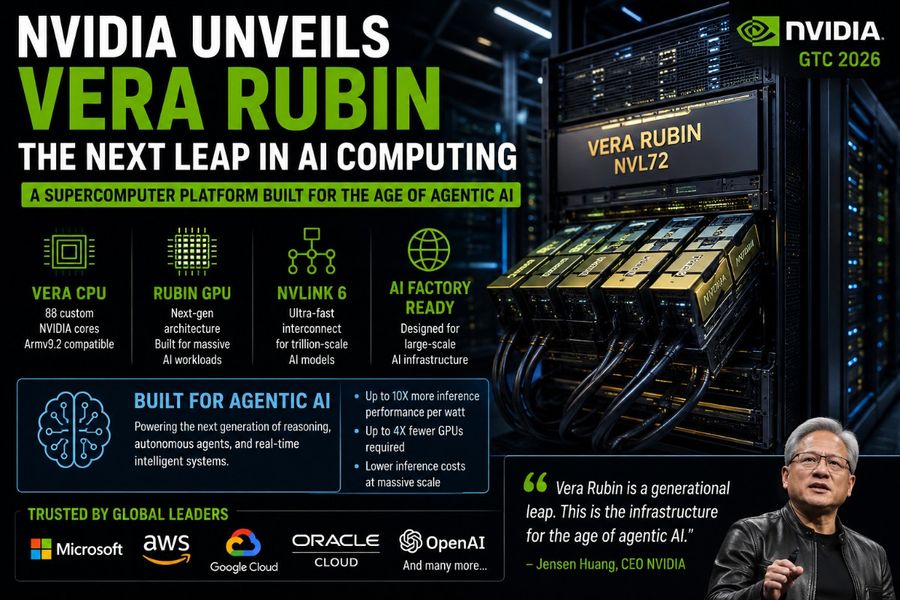
NVIDIA has officially unveiled “Vera Rubin,” its next-generation AI infrastructure platform designed for the era of agentic AI, advanced reasoning systems, and massive AI factories. The new architecture combines powerful Rubin GPUs, Vera CPUs, ultra-fast networking, and AI-native infrastructure into what NVIDIA calls a “rack-scale supercomputer.”
The artificial intelligence war is no longer just about smarter chatbots. It is becoming a battle over who controls the machines powerful enough to run the future. NVIDIA’s Vera Rubin platform shows how rapidly the AI industry is moving beyond traditional computing and toward gigantic AI supercomputer ecosystems capable of training autonomous digital agents at planetary scale.
Announced during NVIDIA GTC, Vera Rubin is not simply another graphics chip launch. The company describes it as a fully integrated AI infrastructure platform built for the next generation of reasoning models, AI agents, robotics systems, and large-scale AI inference networks. Instead of focusing only on GPUs, NVIDIA is now designing entire AI factories — massive computing environments where CPUs, GPUs, networking hardware, cooling systems, and AI software operate as one unified machine.
At the center of the platform is the Rubin GPU architecture combined with NVIDIA’s new Vera CPU. The company claims the system can dramatically reduce the cost of AI inference while delivering several times more performance than current Blackwell systems. NVIDIA believes future AI models will require far greater computational power because upcoming systems will not merely answer prompts but independently reason, plan, remember information, and complete tasks autonomously.
The flagship configuration, known as Vera Rubin NVL72, combines 72 GPUs and 36 CPUs into a single rack-scale AI supercomputer connected through next-generation NVLink networking. NVIDIA says the architecture was designed specifically for agentic AI, a term increasingly used for autonomous systems capable of making decisions and interacting with tools without constant human guidance.
Industry analysts see the announcement as another major step in NVIDIA’s transformation from a chip company into the backbone of the global AI economy. Cloud giants including Microsoft Azure, Amazon AWS, Google Cloud, and Oracle Cloud are expected to adopt the new infrastructure for future AI data centers. Several AI companies developing large language models (LLMs) are also preparing systems optimized around NVIDIA hardware because of its dominance in CUDA AI ecosystems.
However, the launch has also intensified concerns about the growing concentration of AI power inside a small number of technology companies. Critics argue that as AI training becomes more expensive, only corporations with access to NVIDIA-scale infrastructure will remain competitive. Others warn that future AI development could become heavily dependent on a single hardware ecosystem.
Another major concern is energy consumption. AI data centers already consume enormous amounts of electricity, and next-generation AI factories may require unprecedented power infrastructure. NVIDIA insists Vera Rubin is designed to improve performance per watt and reduce inference costs, but environmental questions around the global AI boom continue to grow.
The company also surprised the industry by discussing future space-based AI computing systems. NVIDIA hinted at orbital AI infrastructure concepts capable of handling massive workloads beyond Earth-based data centers, signaling ambitions far beyond conventional server hardware.
Vera Rubin represents something larger than a hardware upgrade. It shows how the AI race is shifting from software innovation toward control over AI compute infrastructure itself. In the coming decade, the companies that dominate AI chips, data center ecosystems, and cloud AI infrastructure may ultimately control the direction of artificial intelligence worldwide.