Rahul Gandhi's Stance on Israel Signals Political Shift
Rahul Gandhi's nuanced stance on Israel signals a potential shift in his political approach. This evolving position is drawing significant attention within the Indian political landscape.
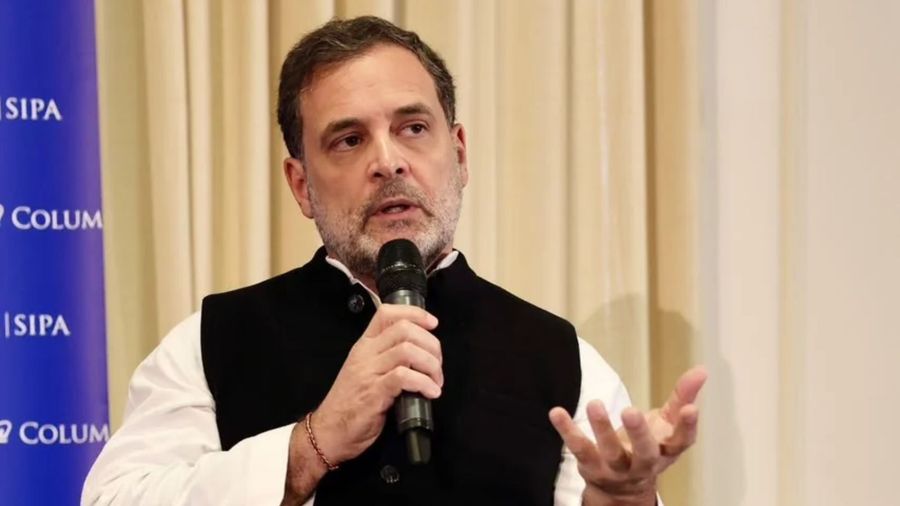
Rahul Gandhi's carefully calibrated approach to the Israeli-Palestinian conflict is drawing considerable scrutiny within the Indian political sphere, suggesting a potential evolution in his political strategy rather than a mere diplomatic exercise. For years, the Congress party and Gandhi have maintained a consistent line emphasizing solidarity with the Palestinian cause, aligning with a long-standing narrative of anti-colonial and pro-Palestinian support that has been a cornerstone of his political identity. This traditional stance has often placed him at odds with segments of the Indian establishment and certain political allies.
The recent nuances in his commentary, however, reflect a more complex engagement with international geopolitics. Instead of outright condemnation, his recent statements have sought to acknowledge the security concerns of Israel while simultaneously advocating for a two-state solution, a diplomatic framework long championed by the Indian government. This pivot is not an abandonment of core principles but rather a strategic attempt to navigate the increasingly polarized global discourse, where unconditional support for one side is politically untenable.
The background context of this shift is the shifting global power dynamics and the growing necessity for domestic political pragmatism. India itself maintains a complex relationship with Israel, balancing strategic defense ties with humanitarian concerns for Palestinians. Gandhi’s attempt to mirror this balanced, multi-faceted diplomacy—rather than adhering strictly to a single ideological banner—signals a maturation in his political outlook.
The impact of this tightrope walk is twofold: it reassures moderate and centrist voters who seek nuanced international engagement, while simultaneously testing the loyalty of his more ideologically rigid base. This measured stance represents a significant, albeit subtle, turning point, indicating a move from purely ideological advocacy to a more pragmatic, globally aware political positioning in his electoral calculus.
Also Read

सचिन पिळगांवकरच्या सिनेमातून मराठी अभिनेत्रीचा बॉलिवूड डेब्यू
सचिन पिळगांवकरांच्या चित्रपटातून मराठी अभिनेत्रीने बॉलिवूडमध्ये पदार्पण केले. तिच्या पहिल्या मोठ्या चित्रपटाने ३०० कोटींचा बॉक्स ऑफिसवर टप्पा गाठला.
The significance of Rahul Gandhi’s measured approach regarding Israel lies in its deviation from more strident, uniformly critical narratives that have characterized segments of Indian political discourse. This nuanced positioning suggests an attempt to navigate complex geopolitical realities rather than adhering strictly to ideological lines. In the context of India's strategic partnerships, particularly with the United States and Israel, this moderation reflects a pragmatic recalibration, acknowledging the multifaceted nature of international relations that transcends singular political critiques.
The possible impact of this shift is twofold. Domestically, it could broaden his appeal among a segment of the electorate that values diplomatic pragmatism over uncompromising rhetoric. Internationally, it aligns more closely with the established foreign policy trajectory of the Indian state, potentially easing friction points in bilateral engagements where India seeks to balance its global commitments. This move signals a political maturity aimed at constructive engagement rather than purely confrontational politics on sensitive global issues.
Moving forward, observers will be closely watching how this stance is applied across other regional conflicts and international alliances. The next critical juncture will be observing his engagement with domestic policy debates alongside his international commentary. Whether this tightrope walk translates into a consistent, policy-driven foreign policy articulation or remains a tactical political maneuver will determine its long-term significance for his political trajectory. The sustained consistency of this measured diplomacy will be the definitive indicator of a genuine political pivot.