Woman clarifies reel usage of caste name Shanaya addressing casteism
Divyanshi Chauhan clarified her viral reel usage of the name Shanaya, addressing claims of casteism. She stated the name selection was not rooted in caste bias but for other reasons.
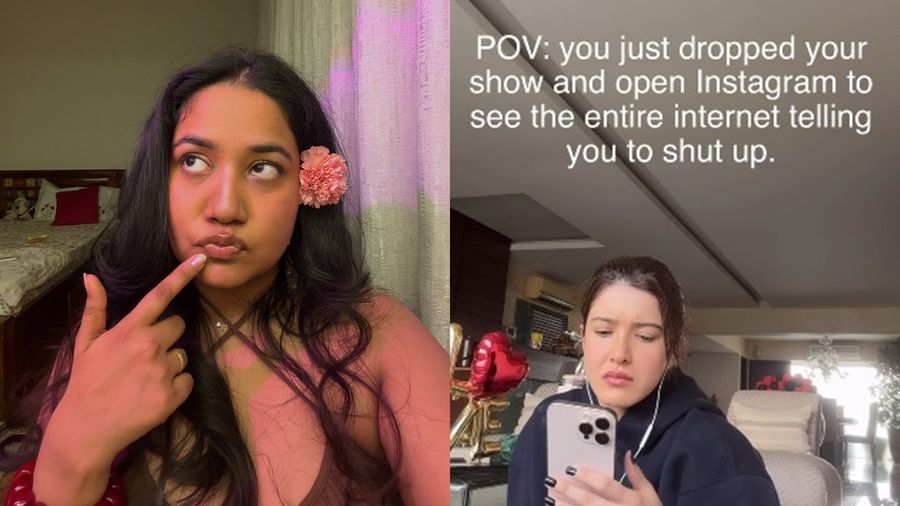
Divyanshi Chauhan has addressed the controversy surrounding a viral reel where she used the name Shanaya, responding to accusations that the content exhibited casteist undertones, notably stating, "Women can be casteist too." The online discourse escalated rapidly after the reel gained significant traction, with critics alleging that the name choice was linked to caste-based prejudice, prompting Chauhan to issue a clarification to dispel these claims.
Chauhan firmly asserted that the selection of the name Shanaya was not motivated by any form of caste bias. She explained that the usage within the reel stemmed from reasons entirely unrelated to caste dynamics, suggesting the online interpretation was a misreading of her intent. This clarification comes amidst a broader societal conversation regarding caste representation and bias in digital media, particularly when presented through the lens of female creators.
The impact of the reel and the subsequent controversy highlights the sensitivity surrounding caste in contemporary Indian social media. While Chauhan maintains her content was benign, the swift and intense backlash underscores how easily cultural nuances can be misinterpreted or weaponized online, leading to accusations of casteism even when not intended. Her response serves as a point of discussion on the need for context in digital critique.
The incident underscores the complex intersection of gender, digital expression, and entrenched social hierarchies in modern India, forcing public figures to navigate both creative freedom and heightened social scrutiny regarding caste sensitivities.
Also Read
भरतपुर जिला परिषद में कांग्रेस 21 सीटों पर विजयी, भाजपा 9, आरएलपी शेष
भरतपुर जिला परिषद चुनाव में कांग्रेस ने 31 में से 21 सीटों पर जीत दर्ज की है। इस परिणाम से मुख्यमंत्री भजनलाल के गृह जिले में भाजपा को बड़ा झटका लगा है।
The clarification provided by Divyanshi Chauhan underscores a broader, nuanced discussion around the intersection of gender, identity, and social prejudice in contemporary digital spaces. Her assertion that women too can exhibit casteist behaviour challenges monolithic assumptions often placed solely on patriarchal structures, forcing a more granular examination of how prejudice manifests across different social demographics. This incident highlights the evolving nature of social discourse online, where seemingly innocuous content can trigger significant social scrutiny and accusations of systemic bias.
The potential impact of this clarification lies in shifting the focus from mere accusation to contextual understanding. It compels observers to look beyond surface-level interpretations of viral content and consider the diverse motivations behind creative expression. For the digital ecosystem, this serves as a reminder that generalizations about casteism, irrespective of the perpetrator's gender, are reductive and fail to capture the complexity of social dynamics in India.
Moving forward, what to watch is not just the trajectory of individual social media debates, but rather the institutional response to such allegations. Greater emphasis is needed on digital literacy that encourages critical consumption of online narratives, moving past immediate judgment to demand factual context. Furthermore, sustained dialogue from cultural commentators and social scientists is necessary to deconstruct the underlying assumptions that lead to such rapid and often unsubstantiated accusations of caste bias in creative works.