Website Efficiency Impacts AI Search Visibility Through Token Economy
A new India benchmark found 84% of median enterprise website responses are code, not content. This highlights a growing need for businesses to ensure essential information is machine-readable for AI discovery, beyond just user experience.
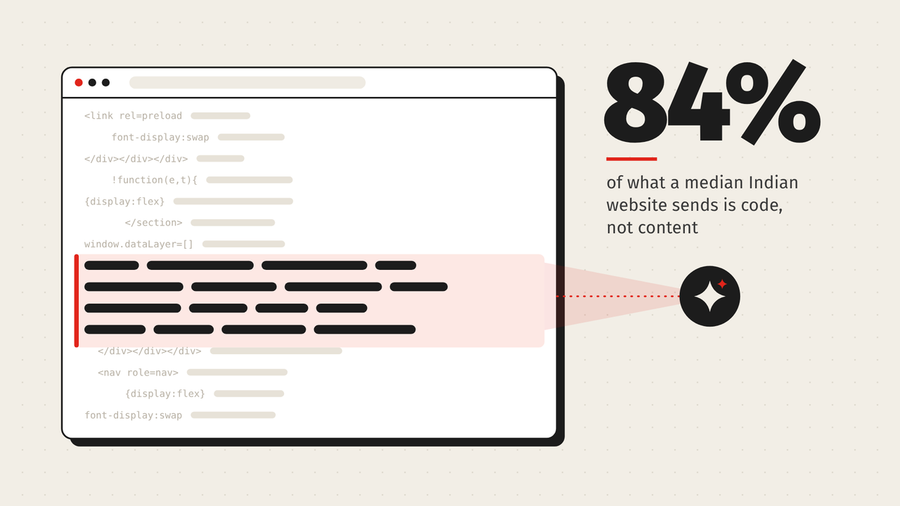
A recent analysis conducted for an Indian news portal reveals a striking finding regarding the digital landscape of Indian enterprises: a significant 84% of median enterprise website responses are primarily composed of code rather than accessible, human-readable content. This metric signals a critical shift in how businesses are presenting information online, moving beyond mere aesthetic user experience to a fundamental issue of machine readability, which is increasingly vital for AI-driven search visibility.
The background context of this observation lies in the rapid integration of sophisticated AI models into search engines across India and globally. These algorithms are not solely designed to satisfy human queries but are increasingly tasked with indexing, summarizing, and delivering precise answers directly from website data. If core business information—such as service details, pricing, or contact information—is buried within complex, non-semantic code structures, AI crawlers struggle to extract it accurately, leading to poor or invisible search rankings.
The impact of this coding-heavy structure is twofold. Firstly, it limits organic discoverability; businesses relying solely on traditional SEO tactics may be missing the emerging paradigm of semantic SEO required by modern AI. Secondly, it risks alienating the very users AI is meant to serve, as the AI cannot effectively synthesize the necessary information for quick, reliable answers.
This benchmark underscores an urgent need for Indian enterprises to audit their digital assets. Optimisation must now extend beyond ensuring a pleasant browsing experience for a human visitor; it must prioritize structured data, clear semantic tagging, and concise, content-first delivery to ensure that essential business information is immediately and accurately consumable by the next generation of AI search tools.
Also Read

Shiv Sena leverages Savarkar references in Sonia Gandhi's book
Shiv Sena has highlighted references to Savarkar within Sonia Gandhi's book. This move is part of the ongoing political discourse surrounding the content and its implications.
The finding that 84% of median enterprise website responses are code rather than accessible content underscores a fundamental shift in digital visibility. Traditional SEO focused heavily on keyword placement and user-facing readability; however, the rise of sophisticated AI search models prioritizes structured, machine-readable data. This means that a website's technical efficiency—how cleanly and accurately its data is structured for ingestion—is becoming as critical, if not more so, than its marketing copy for achieving AI discovery.
The possible impact for Indian enterprises is a necessary pivot from purely aesthetic or marketing-driven web design to data-centric architecture. Businesses that fail to optimize their code structure for AI parsing risk being invisible to the next generation of search engines, regardless of how high their organic traffic currently ranks based on older algorithms. This isn't just a technical tweak; it directly affects lead generation, market reach, and ultimately, revenue streams in a rapidly digitizing Indian economy.
Moving forward, the critical focus must shift to implementing schema markup, JSON-LD, and ensuring semantic clarity across all enterprise platforms. Stakeholders should closely monitor how major Indian search platforms begin to weight structured data versus simple text blocks in their AI summaries. The next phase of this evolution will likely see AI search not just indexing pages, but actively synthesizing answers directly from verifiable, structured enterprise data, making technical compliance a prerequisite for digital relevance.