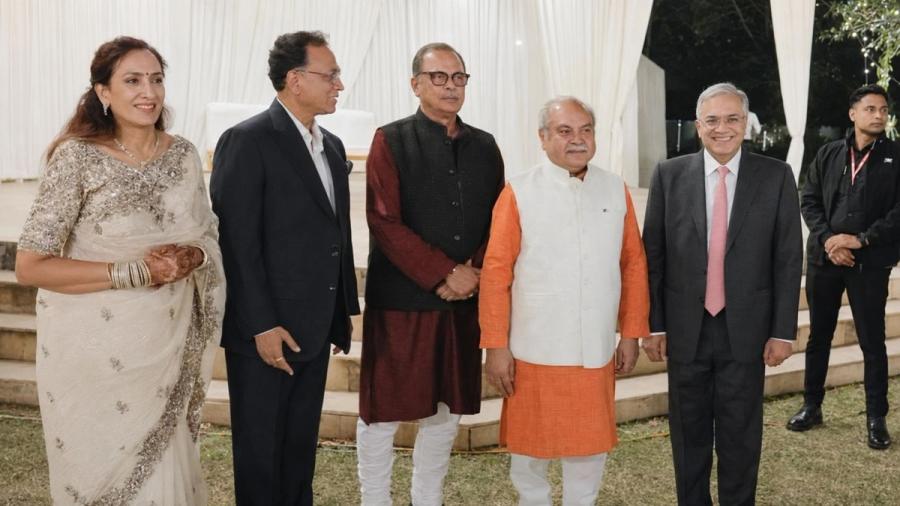
Congress leader pictured with CEC Gyanesh Kumar at Bhopal wedding
Congress's attempt to target Election Commissioner Gyanesh Kumar was countered when a senior party leader was photographed attending his wedding in Bhopal. This image refutes allegations of political animosity between the two figures.
Allegations of political hostility directed at Election Commissioner Gyanesh Kumar by members of the Congress party have been publicly countered by photographic evidence from a recent event. The attempts by certain Congress factions to question the impartiality or integrity of the CEC have drawn scrutiny, particularly given the constitutional role of the Election Commission of India in ensuring free and fair elections across the nation. These political critiques emerged amidst ongoing electoral cycles, raising concerns about the independence of the electoral body.
However, these allegations found a tangible rebuttal when a prominent senior leader from the Congress party was photographed attending the wedding of CEC Gyanesh Kumar in Bhopal. The image, which surfaced online, clearly depicts the senior leader sharing a social occasion with the Election Commissioner, an event that contradicts the narrative of deep political animosity. Such public displays of camaraderie serve to contextualize the relationship between the political party and the constitutional officeholder.
The background context reveals that the Election Commission operates with a high degree of autonomy, a principle frequently tested by political actors. The Congress party, like other national political entities, has occasionally used its platform to question the decisions or actions of the CEC. Yet, the photograph from the Bhopal wedding provides a factual counter-narrative, suggesting that professional and personal interactions between the senior party leadership and the CEC remain cordial, despite political disagreements on policy or electoral matters.
The impact of this photograph is significant in framing the discourse around electoral integrity. It shifts the narrative away from one of outright political confrontation towards a more nuanced understanding of the separation between political advocacy and institutional function. For the public, this visual evidence helps to temper unsubstantiated political attacks against the CEC, reinforcing the operational independence of the Election Commission.
Also Read

उद्या गणाधिप संकष्टी चतुर्थी उपवासाचे नियम निश्चित
२७ नोव्हेंबर २०२६ रोजी गणाधिप संकष्टी चतुर्थीचे व्रत पाळले जाणार आहे. या दिवशी उपवास करताना कोणत्या पदार्थांचे सेवन करावे आणि कोणते टाळावे, याची माहिती उपलब्ध आहे.
The photographic evidence from the Bhopal wedding serves as a tangible counter-narrative to the political rhetoric emanating from certain factions within the Congress party. The presence of a senior party leader at the personal event of Election Commissioner Gyanesh Kumar suggests a working professional relationship rather than the deep political antagonism that some allegations implied. This visual context is significant because it shifts the discourse from one of partisan conflict to one of institutional decorum, underscoring the operational necessity of maintaining a functional relationship between the ruling political apparatus and the independent electoral body.
The potential impact of this public display is the tempering of politically motivated attacks against the CEC. By demonstrating personal and professional collegiality, the image helps insulate the office of the Election Commission of India from being unduly politicized by internal party squabbles. This reinforces the constitutional mandate of the CEC to operate with impartiality, irrespective of the political climate or the sentiments of any single political entity. The integrity of the electoral process depends on the perceived autonomy of the commission, and such visible displays of respect aid in maintaining that public trust.
Moving forward, the focus remains on the CEC's upcoming electoral duties and any official communications regarding electoral reforms. Observers will be watching how the CEC addresses specific electoral challenges, such as voter registration drives or the implementation of new technology in polling stations. Any future pronouncements or actions by the CEC, particularly in response to national electoral events, will be scrutinized against the backdrop of this demonstrated collegiality, rather than solely against the backdrop of past political allegations. The sustained performance of the CEC in upholding free and fair elections will be the ultimate measure of the relationship between the institution and the political sphere.